


“PROfessors” Project. The second episode. Professor Jimbo Claver

SIUT Media Center continues the series of conversations with university professors as part of the “PROfessors” project. Today's guest of the project is Professor of Applied Mathematics - Jimbo Henri Claver from Cameroon.
Good day, professor! Thank you for taking the time to speak with us. We are sure that an exciting conversation awaits us, and our readers, especially the students, will find a lot of useful information in today’s episode!
Hello! It is a great honor for me to be here and to be a guest of this interesting project.

Each episode, we traditionally start by having our guests talk about their childhood, their first steps into the world of science, and how they achieved success in this challenging field.
I was born in Yaoundé, the capital city of Cameroon, in a modest and religious family. The education has always been highly valued in our family. From my earlier school times, I developed a strong passion for science, especially mathematics and engineering. I was curious to study various natural phenomena, understand how and why they happen, and the realization that mathematics underlies much of what happen in real life to some extent fueled my curiosity in this fascinating science even more. This curiosity ultimately gave a strong impetus to the choice of my future career.
Professor, we know that you received your higher education in Russia. Tell us about this stage of your life.
Yes, I took my first serious steps into science at Moscow State University named after M.V. Lomonosov. As you might have guessed, I chose the field of “Applied Mathematics”. It differs from Pure Mathematics in that it allows you to study the reality of the problem being investigated, how it is structured, what drives it, and that there are countless tools that can be applied to solving various problems. Applied Mathematics involves not only solving but also simulating, designing, and even predicting future dynamics. This science is so vast! At MSU, I was fortunate to obtain bachelor's, master's, and doctoral degrees in such exciting and promising field of research.
You didn’t stop there and have worked extensively in other countries. What interesting experiences can you share from your international experience?
Indeed, I did not stop my education after doctoral degree and firmly decided to expand my knowledge in Computing & Applied Statistics. After my PhD, 24 years ago, I applied and obtained several post-doctorate fellowships in Canada, Japan, Australia and Germany respectively. I chose Japan as one of the leading countries in science and technology. In Japan Applied Mathematics holds a special place because the entire essence of Japan is “built” on it. I spent over 15 years actively engaged in scientific activities in Japan. I worked at several universities, such as the Institute of Statistical Mathematics in Tokyo (ISM), Waseda University in Tokyo, Lakeland International University in Tokyo, as well as the Nara Institute of Science and Technology (NAIST) in Nara.
I like facing new challenges, thus, after a productive period of time in Japan, I moved to China, where I had the opportunity to work with the University of Shanghai for Science and Technology (USST). The next destination in my academic journey was the United Kingdom, specifically the University of York – one of the leading research universities in UK and Europe. Additionally, I worked at the American International University (AIU) in Kuwait and the American University of Afghanistan (AUAF).
You have incredibly rich international experience, and it’s very pleasing to see that SIUT found its place in your list. Share your impressions about the university and the achievements that have been made at SIUT.
As I mentioned earlier, I am essentially a person seeking new challenges. New Uzbekistan is undoubtedly a new challenge, as colossal changes are taking place in all areas, especially in science and education. What attracted me in Uzbekistan is the dynamic development of the education system, which strongly involves the engagement of international experts and the transformation of educational programs in line with advanced international standards. SIUT is the embodiment of all these reforms, a concentration of international scientific thought, and I am pleased to be a part of it. In my teaching process, I strive to instill in my students the same feelings I have towards science because curiosity and the desire to discover the unknown make the process of getting acquainted with science more accessible and effective. My classes are always based on logical, structural, and creative thinking, allowing students to understand how important Applied Mathematics is in our lives, how various processes are connected to it, and how one can “predict” the course of certain circumstances.

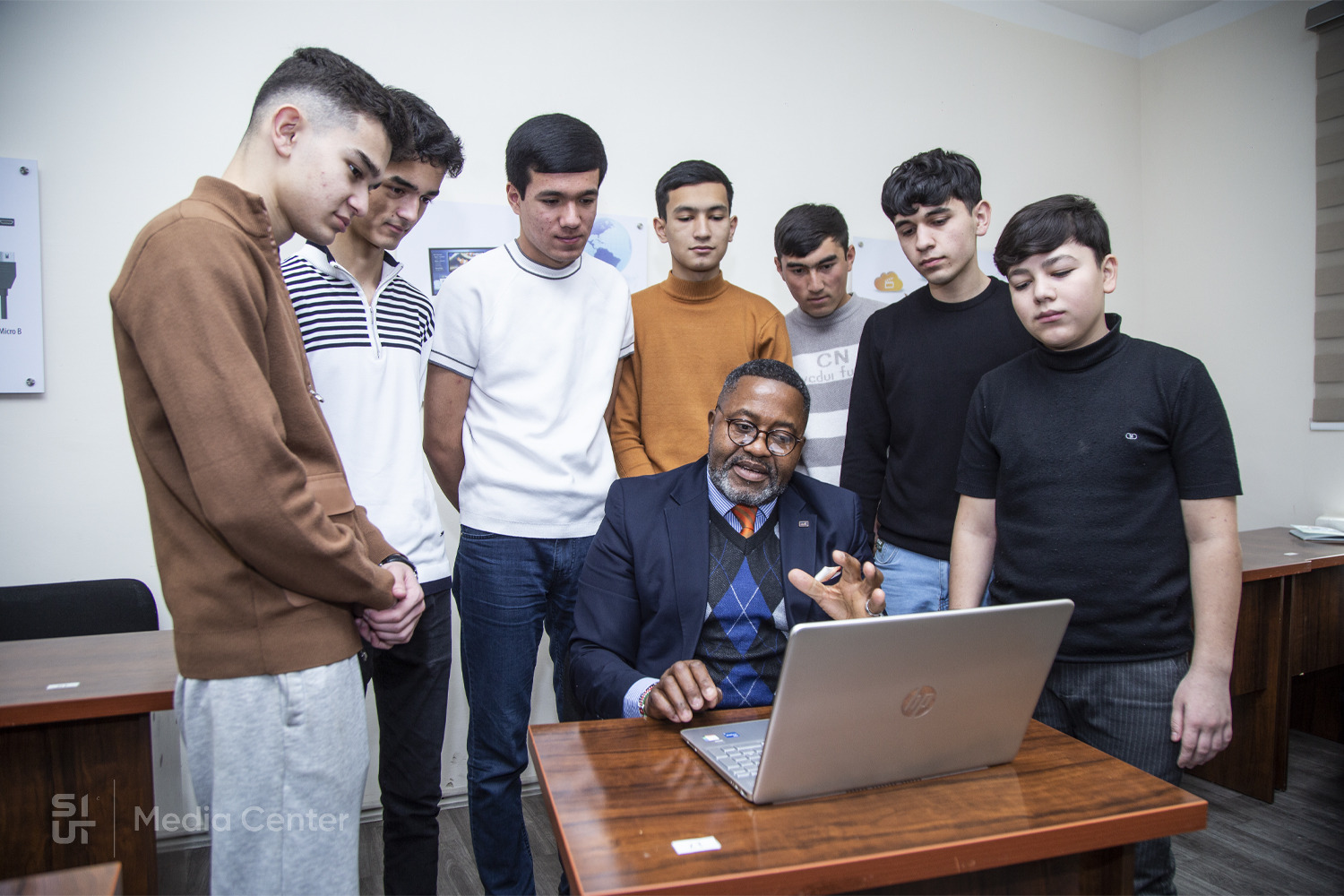
Regarding my experience with SIUT, I cannot fail to mention the friendly atmosphere and the incredibly diverse geographical composition of the faculty, which creates an excellent opportunity for mutual exchange of valuable experiences. In terms of research, the university has also been dynamic, becoming one of the most advanced in science among the universities in Uzbekistan within a year. For me, 2023 has also been quite fruitful. For example, during the Innovation Week (InnoWeek-2023) held in October, defending the honor of the university alongside my colleagues, I was awarded a certificate for active participation in seminars. At the end of the InnoWeek, SIUT was awarded a certificate “For contribution to the creative education and innovative basis for the development of science and technology”. These achievements clearly indicate the rapid growth of scientific potential in our university, and I am proud to be part of this exciting journey. Also, I have participated in various symposiums of Samarkand State University as an invited specialist. I was also invited by the Kattakurgan branch of the Samarkand State University as an international expert to give lectures on “The Future of Fintech in Uzbekistan”. I was awarded with a Certificate of Appreciation.
This year SIUT Department of Applied Mathematics is planning to organize the First International Symposium on Quantitative Finance and Quantitative Risk Management, which will bring together scientists from different countries of the world.

Thank you, Professor, for an interesting conversation! In conclusion, by tradition, we ask the guest to send wishes to our students.
And thank you for the pleasant conversation and for the interesting project. I wish our students, future in-demand specialists, exceptional success, unwavering desire to make the world a better place, and most importantly - to love their work! However, each of us should strive for perfection, because it is the strongest engine of progress!
A lot of meaning lies in your words, Professor! Thank you for your wishes! In turn, we wish you success in your work, new scientific achievements and victories!


